

Discover Algeria's deep religious history
Modern Algeria occupies territory that was once among the most influential Christian regions in the world. It gave Christianity one of its greatest theologians, nurtured influential debates about doctrine and church life, and was home to extensive Christian communities for centuries. While Christianity later declined in the region its intellectual and theological legacy continues to shape global Christianity today, Exploring Christian Algeria is more than a journey through remarkable archaeological sites It is an invitation to rediscover a chapter of Christian history that remains one of the Mediterranean's most extraordinary and least-known treasures.
This was the land of Saint Augustine of Hippo, born in Thagaste (modern Souk Ahras) and bishop of Hippo Regius (Annaba), whose writings transformed Christian theology and Western philosophy. Together with towering figures such as Tertullian and Saint Cyprian, the Church of North Africa helped define the language, doctrine, and intellectual tradition of Latin Christianity.
The history of Christianity in Algeria is also the story of remarkable courage. During periods of Roman persecution, countless believers gave their lives for their faith, leaving behind some of the earliest and most moving Christian testimonies. The Passion of Saint Cyprian, the Passion of Saints Maxima, Donatilla and Secunda, the accounts of Maximian and Isaac, and the stories of martyrs such as Marculus, Saint Crispina, Perpetua, Felicity, and Saint Felix reveal communities whose steadfast faith inspired Christians throughout the Roman world.
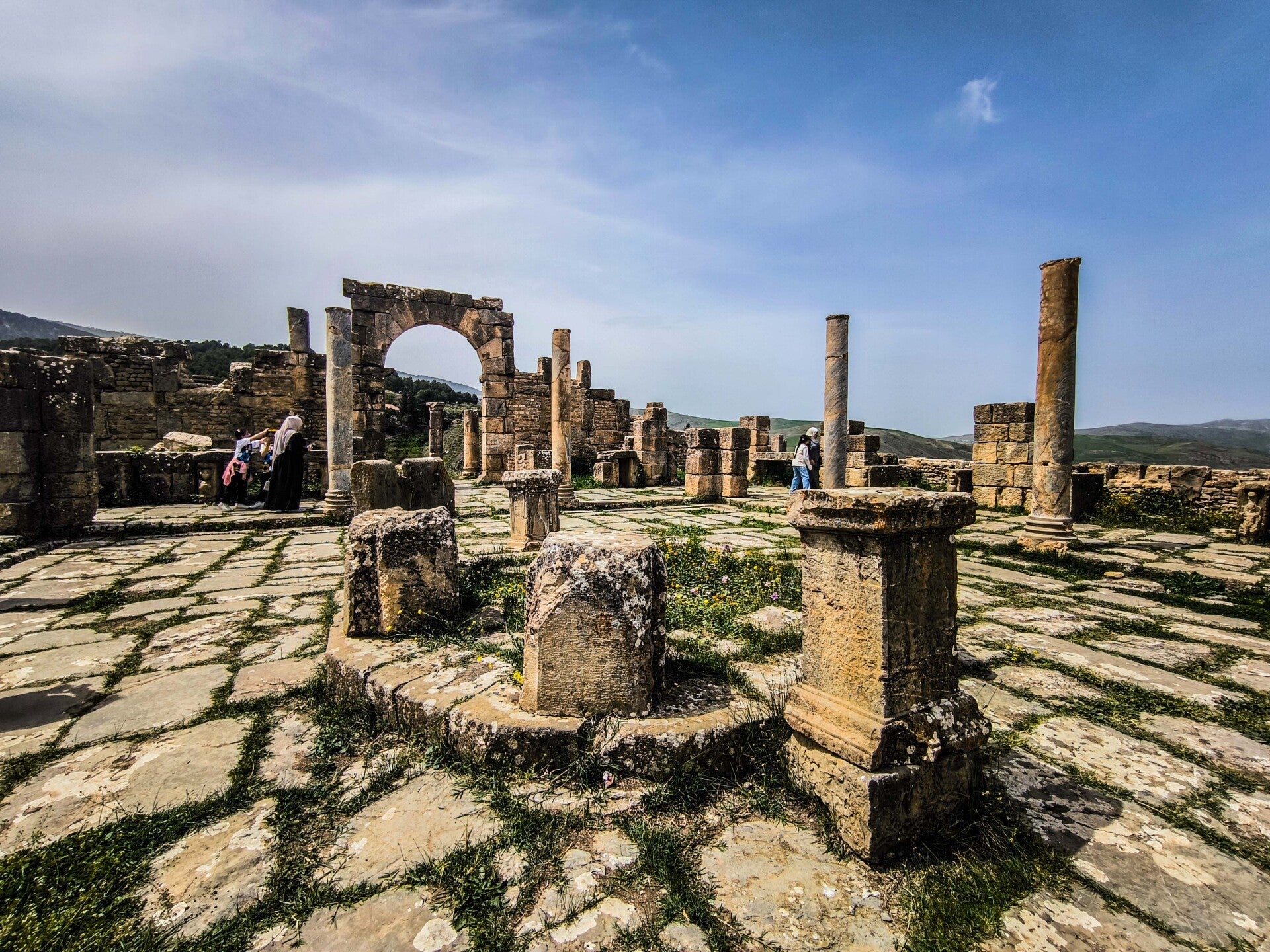
Today, visitors can still walk through the landscapes where this history unfolded. The archaeological sites of Hippo Regius, Timgad, Djemila, Tipasa, Lambaesis, and Cherchell preserve the remains of ancient churches, baptisteries, Christian mosaics, episcopal residences, inscriptions, and cemeteries, offering a rare glimpse into one of Christianity's earliest flourishing civilizations.


ANNABA : on the steps of Saint Augustin
The discovery of the ancient ruins of Hippo, an iconic archaeological site from the history of the Roman Empire. This was the city where Saint Augustine lived for much of his life. You will also visit the Hippo Museum, which houses fascinating artifacts dating back to the Roman era.
In Annaba the Basilica of Saint Augustine is considered as a symbolic site of the Christian faith. The day concludes with participation in Mass at this sacred place, an important spiritual moment of the pilgrimage.
SOUK AHRAS ou Thaghaste
Souk Ahras, the ancient city of Thagaste, the birthplace of Saint Augustine (354–430 AD), one of the most influential theologians and philosophers in Christian history. Located in eastern Algeria, Thagaste was originally a thriving Numidian settlement before becoming a prosperous Roman municipium. It was here that Saint Augustine spent his childhood and received his early education before continuing his studies in Carthage. The city played an important role in the cultural and intellectual life of Roman North Africa. During your visit, you will explore the Thagaste Museum, which displays a remarkable collection of Roman mosaics, inscriptions, sculptures, pottery, and everyday artifacts that illustrate the city's rich past. A walk through modern Souk Ahras, where traces of the ancient city can still be found, offers an opportunity to immerse yourself in the history and heritage of this significant archaeological and spiritual destination


MADAURE
Madaure, another important stop on the pilgrimage, is renowned as the ancient city where Saint Augustine pursued his higher education. Before arriving in Madaure, the journey includes a visit to Khemissa (ancient Thubursicum Numidarum), one of Algeria's finest Roman archaeological sites. There, you will explore remarkably preserved ruins, including a theater, forum, temples, baths, and paved streets, reflecting the prosperity and importance of this city during the Roman Empire.
you will discover the archaeological remains of this celebrated Roman and Numidian city, famous for its distinguished school It was here that the young Saint Augustine continued his education before moving on to Carthage. Madauros was also the birthplace of the celebrated Latin writer Apuleius, author of The Golden Ass, highlighting the city's reputation as a major intellectual and cultural center of Roman North Africa. As you walk among its ancient streets, forum, baths, and other surviving monuments, you will gain a deeper appreciation of the environment that shaped one of Christianity's greatest thinkers and the rich classical heritage of the region.
CONSTANTINE, capital of the east
Morning visit to the city of Constantine and its Archaeological Museum. Known in antiquity as Cirta Regia, Constantine was the capital of the Kingdom of Numidia under the reign of King Massinissa, one of the greatest rulers of ancient North Africa. Following the Roman conquest, the city became an important administrative and cultural center of the Roman Empire. The Archaeological Museum of Constantine houses an outstanding collection of Roman mosaics, sculptures, inscriptions, and artifacts that illustrate the region's rich Numidian and Roman heritage.
Perched dramatically atop a rocky plateau and surrounded by the deep gorges of the Rhumel River, Constantine has often been described as an 'eagle's nest,' a comparison famously made by Alexandre Dumas because of its spectacular natural setting. The city's iconic suspension bridges, spanning the impressive ravines, offer breathtaking panoramic views. Among them, the Sidi M'Cid Bridge, soaring approximately 175 meters (574 feet) above the Rhumel Gorge, provides access to the historic Casbah and is considered one of Constantine's most remarkable engineering landmarks.
Within the Casbah, you will visit the Palace of Ahmed Bey, one of the finest surviving examples of Ottoman architecture in Algeria. Built in the early 19th century, the palace was the residence of Ahmed Bey, the last Ottoman governor (Bey) of Constantine, who became renowned for his determined resistance against the French conquest following the invasion of Algeria in 1830. Richly decorated with marble, painted ceilings, ceramic tiles, and elegant courtyards, the palace stands today as a powerful symbol of Algeria's cultural heritage and its struggle to preserve its independence."


TIPASA, on the path of the martyrs.


Tipasa, one of Algeria's most remarkable archaeological treasures, is a UNESCO World Heritage Site where the civilizations of the Phoenicians, Romans, and early Christians left an extraordinary legacy. Situated on the Mediterranean coast about 70 kilometers west of Algiers, the ancient city flourished as an important Roman colony in the 1st-2nd century AD.
During your visit, you will explore the extensive archaeological park, where remarkably preserved ruins stretch along the coastline. Highlights include the Roman theater, amphitheater, forum, basilicas, public baths, villas adorned with mosaics, all set against the stunning backdrop of the Mediterranean Sea. The site offers a unique glimpse into daily life in Roman North Africa and illustrates the prosperity of Tipasa during the height of the Empire.
Tipasa also holds exceptional significance for Christian history. The city became an important center of early Christianity, and visitors can discover the remains of several basilicas, including the Great Basilica, the Basilica of Bishop Alexander, and one of the largest Christian cemeteries in Roman Africa. including the "martyriums"; the toumbs of the revered martyrs of christianity.
The visit concludes at the Royal Mausoleum of Mauretania, located a short distance from Tipasa. This monumental circular tomb, dating to the 1st century BC, is traditionally believed to be the burial place of King Juba II and Queen Cleopatra Selene II, daughter of the famous Egyptian queen Cleopatra VII and Mark Antony. it stands as one of North Africa's most iconic ancient monuments, reflecting the region's rich local cultural and historical heritage.
| STEPS : |
|---|
| Day 1: ALGIERS - CASBAH - ANNABA |
| Day 2: ANNABA |
| Day 3: ANNABA - SOUK AHRAS - ANNABA |
| Day 4 : ANNABA - MADAURE - CONSTANTINE |
| Day 5: CONSTANTINE - ALGIERS |
| Day 6: TIPAZA |
| Day 7 : ALGIERS |